




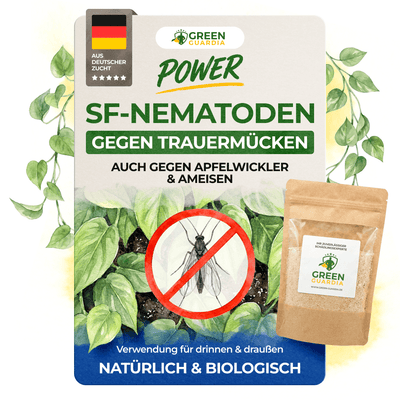






















Combating fungus gnats with SF nematodes and yellow sticky traps
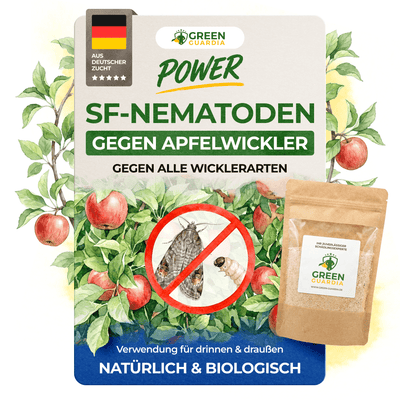
Small black flies rising from your flower pots when watering? This is often caused by fungus gnats. By combining GREEN GUARDIA SF nematodes and yellow sticky traps, you target them in two ways: The nematodes combat the larvae in the potting soil, while yellow sticky traps catch flying fungus gnats and make it easier to monitor the infestation.
Identifying fungus gnats: small black flies in the potting soil
Fungus gnats are small, mostly dark-colored gnats with a slender body, long legs, and delicate antennae. They are often noticed on houseplants when they crawl close to the soil or fly up from the pot when watered.
The adult insects are mainly a nuisance. The critical factor for potential plant damage is the fungus gnat larvae in the soil. They feed on fungi and decomposing organic material, among other things, but can also damage sensitive roots. Seedlings, cuttings, and young plants are particularly at risk.
Typical signs of fungus gnats
- Small dark gnats on the soil surface and rim of the pot.
- Insects flying up when watering or moving the planter.
- Repeated catches of small gnats on yellow sticky traps near the potting soil.
- Glassy whitish larvae with a clearly dark head capsule in the damp substrate.
- With a heavier larval infestation, weakened young plants and impaired root development.
Stunting growth alone does not prove a fungus gnat infestation. Waterlogging, root rot, or unsuitable location conditions can also weaken plants. Therefore, additionally check for the typical insects.
Fungus gnats or fruit flies?
Fungus gnats are frequently found on damp plant soil. Fruit flies usually appear more compact and tend to gather around overripe fruit, fermenting food, or organic waste. SF nematodes in flower pots do not trigger a fruit fly infestation with a different breeding source.
Why combine SF nematodes and yellow sticky traps against fungus gnats?
If you only fight the visible gnats, you overlook the larvae in the substrate. If you exclusively treat the soil, you may initially continue to see adult insects. Our combination addresses both areas.
In the soil: SF nematodes against the larvae
Steinernema feltiae is applied with the watering water and combats suitable fungus gnat larvae in the substrate. As a result, fewer larvae can complete their development into adult gnats.
Above ground: Yellow sticky traps against flying insects
The yellow adhesive surfaces attract adult fungus gnats and trap them securely. At the same time, you can see which plants still have flight activity. The larvae in the soil are not reached by yellow sticky traps.
GREEN GUARDIA SF nematodes against fungus gnat larvae
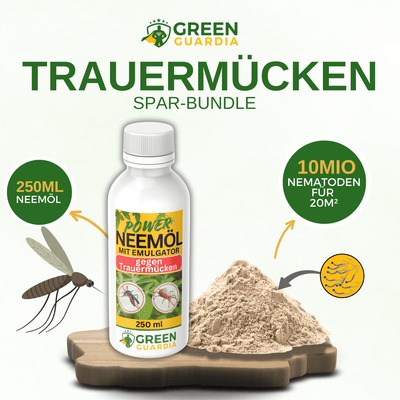
Our SF nematodes are living, microscopic roundworms of the species Steinernema feltiae. They are stirred into water and poured onto the affected potting soil. There they can infect suitable larvae and kill them together with their symbiotic bacteria.
This means biological treatment targets where the next generation of fungus gnats develops: in the damp substrate. Treating the leaves is not necessary for this purpose.
Why SF nematodes are suitable for flower pots
- They are easily applied with the watering water.
- They reach suitable larvae in the substrate that are not caught by sticky traps.
- They can be combined with yellow sticky traps.
- A complete replacement of the potting soil is normally not required for the treatment.
What pack size do I need?
Choose the quantity based on the coverage area and application instructions specified on the product. Take into account all affected containers and the substrate area to be treated. A fixed number of pots cannot be applied to every package because pot diameters and container sizes vary.
Do not dilute a too small amount of nematodes arbitrarily across additional pots. More water does not replace a sufficient application rate.
What SF nematodes need to be effective
- A suitable substrate temperature according to the product instructions.
- Already slightly damp soil during application.
- Even moisture during the prescribed active phase.
- Protection against drying out, direct sunlight, and unsuitable storage.
GREEN GUARDIA yellow sticky traps against flying fungus gnats
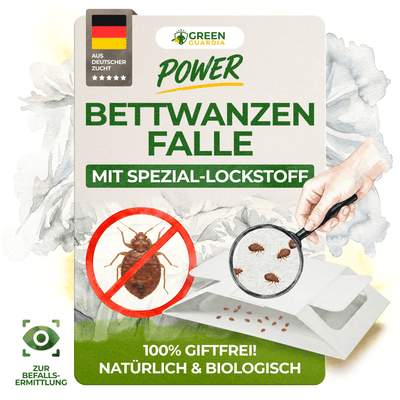
Our yellow sticky traps against fungus gnats supplement the larval treatment by SF nematodes. They catch adult insects on the plant and make flight activity visible.
Place the traps near the soil surface or according to the product instructions in the immediate vicinity of the plant. The adhesive surfaces should remain free and neither stick to leaves nor be covered with soil.
How to use yellow sticky traps effectively
- Set up near the affected plants, instead of just in a remote spot in the room.
- Provide enough trapping locations if there are multiple infested containers.
- Check catches regularly to identify active infestation areas.
- Replace heavily covered or dirty adhesive surfaces.
- Place out of reach of children and pets so no one sticks to the adhesive surface.
Yellow sticky traps act as a trapping surface from the moment of placement. However, they neither eliminate eggs nor larvae in the pot. For an existing infestation, combining them with SF nematodes is therefore particularly sensible.
Combating fungus gnats: applying SF nematodes and yellow sticky traps correctly
1. Check infested plants and neighboring pots
Check which containers the gnats are flying up from. Also check nearby plants, propagation trays, and damp substrate residues. An overlooked breeding source can cause insects to continue appearing in the room.
2. Place yellow sticky traps
Set up the yellow sticky traps by the affected plants. This starts you off with catching adult insects and allows you to better observe further development.
3. Prepare soil for the nematodes
Check the substrate temperature and carefully moisten very dry soil first. The subsequent nematode solution should distribute itself in the root ball and not immediately run past dry edge areas.
4. Mix fresh SF nematodes
Mix the nematodes with the amount of water specified on the packaging. Follow the instructions on dosage and handling. Stir the mixture regularly during application so the nematodes do not settle.
5. Pour evenly onto the soil
Distribute the solution over the intended substrate areas. For fungus gnat larvae, the treatment must reach the soil, not just leaves or the outer pot. Avoid unnecessary runoff of large amounts into the saucer.
6. Ensure moisture during the active phase
Keep the substrate sufficiently moist for the duration specified in the instructions. Excess water should be able to drain away. Moist does not mean that the pot should stand in water permanently.
7. Continue monitoring yellow sticky traps
Leave the trapping surfaces in place during the treatment and replace them as needed. Observe in particular the number of newly added insects. Old catches remain visible on the trap and do not say on their own whether the current infestation is decreasing.
How quickly do SF nematodes and yellow sticky traps help?
Yellow sticky traps can catch flying insects right after placement. SF nematodes first require contact with suitable larvae in the substrate. When the number of gnats visibly decreases depends, among other things, on temperature, infestation severity, and correct application.
Do not expect all adult fungus gnats to disappear immediately after watering. Flies already present are not directly reached by the soil treatment. Additional insects may also emerge initially from unreached developmental stages.
How do you recognize an improvement?
- Fewer and fewer insects fly up when watering.
- Fewer new catches accumulate on fresh yellow sticky traps over a comparable period.
- Less activity is observed at the affected pots.
- Weakened plants can recover provided there is no other cause of damage.
When is a repetition advisable?
If infestation persists, a further application according to product specifications may be necessary. Check beforehand whether the soil was sufficiently moist during the active phase, the temperature was right, and all relevant containers were taken into account.
A repetition does not solve an overlooked breeding source outside the treated pots. Therefore, also check damp propagation soil, plant residues, and other permanently damp substrates.
Why do fungus gnats occur and how do you prevent them?
Fungus gnats can be introduced with plants or substrate and re-colonize suitable pots. Permanently damp, organic substrates offer favorable conditions for many species.
An infestation does not automatically prove a care error. However, frequent watering and poorly drying soil can encourage reproduction.
Watering according to needs after treatment
Adjust watering behavior back to the plant species after completing the intended active phase. For suitable plants, the surface may dry out slightly between waterings. The entire root ball should not dry out uncontrollably in the process.
Check drainage and substrate
Use planters with functioning drainage holes and a substrate suited to the plant. Remove excess water from saucers and outer pots. A layer of expanded clay neither replaces water drainage nor a suitable watering amount.
Store soil and plant residues correctly
Store opened bags of soil protected and avoid open, permanently damp substrate residues lying around. Remove dead plant parts from the surface of the pot. You should carefully monitor new plants initially.
Do not overestimate surface coverings
Covering the soil can change the accessibility of the surface, but does not replace reliable larval treatment. It can also make moisture assessment difficult. When using nematodes, ensure that the solution reaches the actual substrate.
Home remedies or SF nematodes against fungus gnats?
Home remedies like cinnamon, coffee grounds, or matches are frequently recommended, but do not offer a reliably predictable control of all fungus gnat stages. Additional organic material on damp soil can promote unwanted decomposition processes.
With SF nematodes and yellow sticky traps, on the other hand, you pursue a clear approach: biologically combating suitable larvae in the substrate and catching flying insects with adhesive surfaces. The crucial factor remains correct application.
Frequently asked questions about fungus gnats, SF nematodes, and yellow sticky traps
What helps against fungus gnats in potting soil?
Our recommended combination consists of SF nematodes against suitable larvae in the substrate and yellow sticky traps against flying insects. Additionally, you should avoid waterlogging and check for possible further breeding sources.
Why are yellow sticky traps alone not enough?
Yellow sticky traps catch adult fungus gnats, but do not reach larvae in the soil. These can continue to develop. SF nematodes complement fly catching with targeted larval treatment.
Why should I use yellow sticky traps in addition to SF nematodes?
Soil treatment does not directly target adult gnats. Yellow sticky traps catch some of these insects and help you monitor the course of the infestation.
What does SF mean in nematodes?
SF stands for Steinernema feltiae. This nematode species is used for the biological control of fungus gnat larvae. A product with a different nematode species is not automatically interchangeable.
How do I apply SF nematodes in a flower pot?
Stir the nematodes into water according to the packaging instructions and pour the solution evenly onto the already slightly damp soil. Observe dosage, substrate temperature, and the required moisture during the active phase.
Should I keep the soil dry or leave it damp?
During nematode treatment, the substrate remains evenly moist according to instructions, without waterlogging. Only after the intended active phase can you allow the surface to dry out more for plants suitable for this.
Do I have to treat all houseplants?
Check all nearby pots for infestation. Take into account affected containers and other verifiable breeding sources during treatment. Yellow sticky traps help identify active areas. Not every plant in the household is automatically infested.
Do I need to repot because of fungus gnats?
Repotting is normally not required for treatment with SF nematodes. With unsuitable substrate, root rot, or persistent waterlogging, it may be sensible to check the root situation independently of this.
How many yellow sticky traps do I need?
This depends on the number and distribution of affected plants as well as the product instructions. Place enough trapping locations in the immediate vicinity of the plant if there are multiple infested pots.
When do I need to replace yellow sticky traps?
When the adhesive surface is heavily covered with insects, dusty, or otherwise soiled. Fresh traps also make it easier to compare newly added catches.
Why are fungus gnats still flying after treatment?
Adults already present are not directly combated by SF nematodes. Developmental stages not reached or untreated breeding sources can also produce more insects. Continue using yellow sticky traps and check application requirements.
Can I store SF nematodes?
Follow the storage temperature and shelf life specified on the packaging. Nematodes are living organisms and should be used as promptly as possible. A prepared solution is not intended for indefinite storage.
Do fungus gnats sting humans?
Fungus gnats are not blood-sucking mosquitoes. Indoors, the flying insects are primarily a nuisance. Plant protection focuses in particular on the larvae in the substrate.
Do SF nematodes help against fruit flies?
Treating potting soil is not a suitable solution for fruit flies that develop, for example, in fermenting fruit. Identify the insects first and look for their actual breeding source.
How do I prevent a re-infestation?
After completing the nematode active phase, avoid unnecessarily persistently wet soil, store substrate protected, and inspect new plants. Yellow sticky traps can help notice renewed flight activity early.