








































Spider Mites: Recognizing Speckling & Webbing – Natural Control
Spider mites are tiny, sap-sucking pests that quickly become a problem—especially in dry, warm air—in your home, greenhouse, or garden. Typical signs are light speckling on the leaves and, in cases of severe infestation, fine webbing. Learn here how to reliably identify spider mites and which natural measures truly provide lasting relief.
What are spider mites?
Spider mites are not insects, but belong to the mite family. They are usually found on the underside of leaves and feed on plant sap. This creates many small feeding marks that appear as light-colored dots. In the event of a severe infestation, spider mites form fine webs that can cover leaves and shoot tips.
How to recognize an infestation
- Light speckling (“dotted” leaves) – especially on the upper side of the leaf
- Leaves appear dull, silvery, or “bleached”
- Fine webbing on shoot tips or the undersides of leaves (in case of severe infestation)
- Leaf yellowing, leaf drop, weak growth
- Tiny, moving dots on the underside of the leaf (easier to see with a magnifying glass)
Which plants are frequently affected?
- Houseplants (e.g., Monstera, Ficus, palms, orchids)
- Container plants (e.g., citrus, oleander)
- Vegetables in the greenhouse (e.g., cucumbers, tomatoes)
- Ornamental plants and roses (depending on location)
Why does an infestation occur?
- Dry heating air / low humidity
- Warm locations, heat accumulation (windowsill, conservatory)
- Weakened plants (lack of water, stress)
- Introduction via new plants
What to do in case of infestation? (natural & effective)
1. Immediate measures: shower off & reduce
- Thoroughly shower the leaves (especially the undersides)
- Remove heavily infested leaves/shoot tips
- Isolate the plant (for houseplants)
2. Increase humidity & optimize location
- Increase humidity (e.g., bowl of water, humidifier)
- Avoid heat accumulation, do not place the plant directly over a heater
- Water consistently (reduce stress)
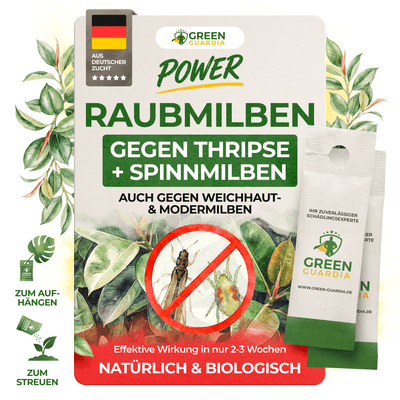
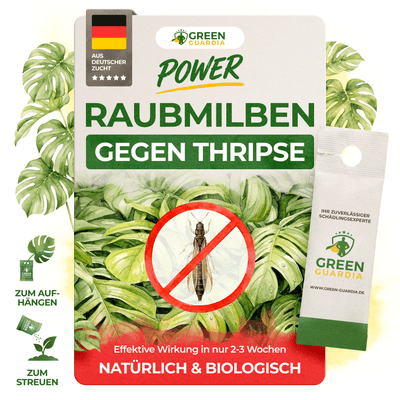
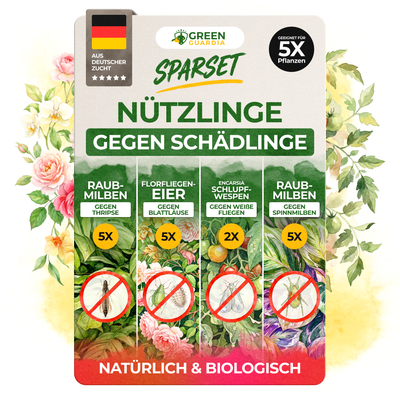
Beneficial organisms for spider mites: Predatory mites
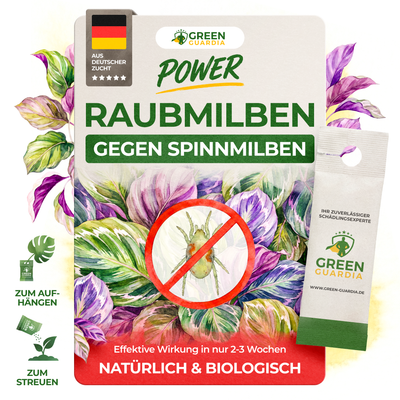
Predatory mites are the most proven natural solution for spider mites. They eat spider mites (eggs, larvae, and adults) directly on the leaves. They are particularly effective indoors and in the greenhouse.
Recommendation: Phytoseiulus / Neoseiulus (depending on the situation)
- Why they fit: Predatory mites actively seek out spider mite colonies on the undersides of leaves.
- Why they are useful: They reduce all stages of development and slow down the cycle.
- Practical tip: Combine showering + predatory mites – this way the infestation decreases faster.
FAQ about spider mites
Why do spider mites keep coming back?
Often, a residual population remains on the undersides of leaves or in dense plant crowns. Additionally, dry air favors rapid multiplication – which is why location and humidity are decisive factors.
Is “removing webs” or wiping them off enough?
That reduces the infestation in the short term, but often does not solve the problem permanently. The combination of immediate reduction (showering) and sustainable regulation (predatory mites) is crucial.
What is the best way to prevent spider mites?
Keep plants stress-free, do not let them get too dry, improve humidity, and check new plants before placing them with others (quarantine).
Can I still save affected leaves?
Light speckling often remains visible, even if the infestation has been stopped. It is important that new growth emerges healthy and no new webs form.